In recent years, Thoroughbred racing has been blessed by a plethora of talented fillies and mares who have vied for the title of “Queen of Racing.” From Rachel Alexandra, to Royal Delta, to the incomparable Zenyatta, to the current queen Beholder, flat racing in the early 21st century will be remembered for the amazing girls who have taken on the boys and won. But there was another Queen over 120 years ago who throws their records into the shade. Her name was Goldsmith Maid.
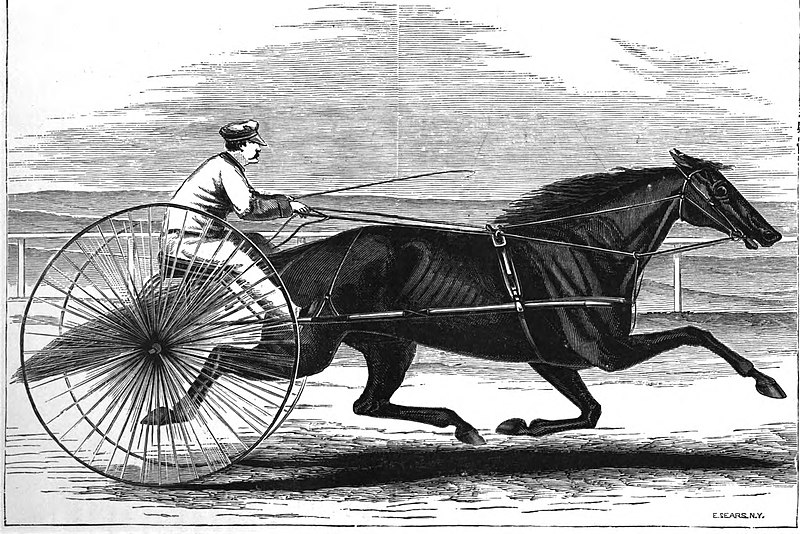
Goldsmith Maid, etching by John McAuliffe, published in 1877 in Famous American horses by Porter and Coates (Philadelphia: Henry B. Ashmead Publisher)
Goldsmith Maid was a trotting horse, who raced in an era when heat racing was still the norm. Her career spanned thirteen years and 121 races (according to the historical marker at her birthplace) or 132 races (according to her New York Times obituary). Those races encompassed more than 300 heats of a mile each, pulling the high-wheeled, 60 pound sulkies that were common at the time, a far cry from today’s low profile, light-weight “bikes.”
Born in May, 1857 on John B. Decker’s farm in Deckerville, NJ she was a small, wiry blood bay who stood only 15 hands when fully grown. Her dam was a mare by Abdallah, a grandson of the Thoroughbred stallion Messenger, the primary foundation stallion of the Standardbred breed. Decker had bought her from a peddler and bred her to Alexander’s Abdallah, a son of Rysdyk’s Hambletonian, who was also sired by Abdallah. Named Maid, the filly was closely inbred to the “famous rat-tailed stallion.”
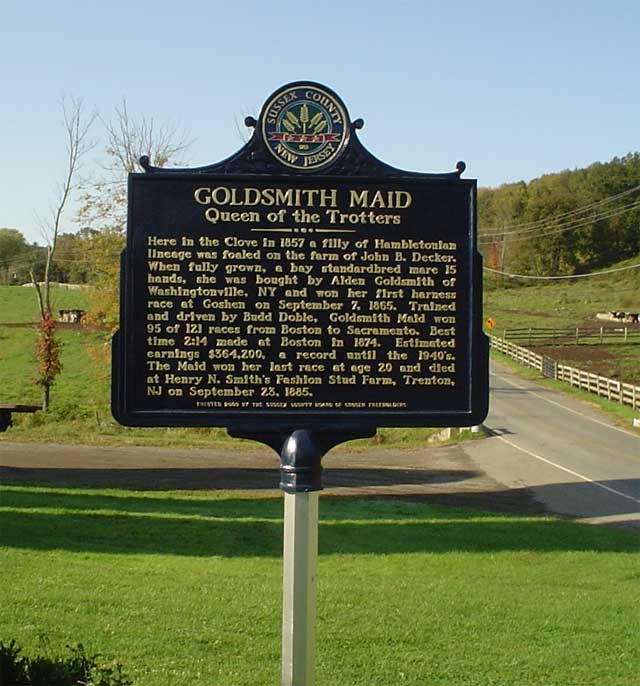
The historical marker at the Maid's birthplace in New Jersey
Unlike her mother, Maid was a wild child. She was “ungovernable” and “wild as a prairie horse.” She refused to work and was fond of jumping fences -- and kicking them down if they were too high to jump easily. She fell over backwards when she was hitched to a harrow, kicked buggies to bits, and ran away with a wagon. Known to the neighborhood as “Decker’s worthless mare,” she spend her days running wild in the fields until the age of eight, when she was sold to Decker’s nephew, John H. Decker for $260 at the urging of the elder Decker’s wife. John H. sold her on to William Tompkins for $360 but regretted the sale. He told Alden Goldsmith about the mare, who had often been “borrowed” from his uncle’s fields at night by local young men (in collusion with the hired man) to run in impromptu races. Goldsmith bought her from Tompkins for $600 and sent her to William Bodine to be trained. It took a while to teach her how to trot, but once she got the idea she became “perfectly tractable.”
Her racing career began at age eight on September 7, 1865 at Goshen, New York where she trotted against Uncle Sam, Mountain Boy, and Wild Irishman. At the time, trotting races were run in heats. Each heat was one mile and in order to win the purse, a horse had to win three heats. Goldsmith Maid won her first race in three straight heats, trotting the mile in 2:39 in the first heat, 2:36 in the second, and 2:39 in the third. She finished the year with two more races, winning one.
At age 9, she trotted in eight races, winning seven. The following year, at age 10, she won three of five races. This was also the year of her first major race, on June 6 at Newburg. She trotted the mile in 2:24 ¼. At age 11, in 1868, she won eight times, lowering her personal record for the mile to 2:21 ½ at Mystic Park on October 7. She was sold that fall to Bud Doble for $20,000.
In 1868, at the age of 12, Goldsmith Maid became the first horse ever to go three heats in less than 2:20 each when she beat American Girl at Suffolk Park, Philadelphia. Earlier in the year, she had been beaten by American Girl five times. By the end of the year, she had won a total of eight races and beaten every horse who had beaten her that year, except for Lady Thorne, who beat her five times. At age 13, the Maid won eleven times and went a mile in 2:24 ½ while hitched to a wagon.

"The brush on the homestretch : Between American Girl, Lucy, Bashaw Jr., Goldsmith Maid, Rhode Island and George Wilkes. In the last heat of their great trot on the Prospect Park Fair Grounds May 29th 1869" (Currier & Ives, 1869)
At age 14, in 1871, she beat all comers at Fleetwood Park, Baltimore, Prospect Park, Brooklyn, Boston, and Buffalo, where she attempted to beat Dexter’s mark of 2:17 ¼ for an extra purse, but failed. Later on, she beat his mark at Milwaukee, going a mile in 2:17. After that race, she was sold to Henry N. Smith for $35,000. She continued racing on the Western Route, going as far west as Omaha and Council Bluffs. In 1872, she went in 2:16 ¾ at the Mystic course in Boston and went three heats in less than 2:20 two more times. She also traveled to the West Coast for the first time. She was 15 years old.

"The celebrated trotting mare 'Goldsmith Maid' driven by Bud Doble. Trotting in harness at Buffalo, August 11th, 1871, mile heats best 3 in 5, time 2:19 3/4, 2:19 1/4, 2:19, beating 'Lucy' and 'American Girl'" Currier & Ives, 1871.
According to Coates, she “did not trot any particularly fast heats” in 1873 but in 1874, at age 17, she won seventeen of seventeen races and went three heats in under 2:20 three times. At Rochester, she went a second heat in 2:14 ¾. On September 14, she trotted for a special purse at Mystic Park, Boston, trying to beat her own record set at Rochester. She went the mile in 2:14, which would be her personal best. At age 18, she trotted six races, losing only once. The following year she won seven of eight races, going three heats at Buffalo on August 3 in 2:16, 2:15 ¼, and 2:15. On June 23, she matched her record of 2:14 at Belmont Park, Philadelphia, and went a mile in 2:14 ½ over the same track on November 4.

"The race between Goldsmith Maid and Rarus, Los Angeles, Ca." Carleton Watkins, c1877.
In 1877, the Maid was 20 years old and she once again raced in California. On May 19 at Chico, she beat Rarus over “a rough track” (Coates) in 2:19 ½, 2:14 ½, and 2:17 Her last race was at Toledo on September 7, where she went three heats in 2:23 ½, 2:21 ½, and 2:22. She retired at the age of 20 with a record of 95 wins (according to Coates) or 92 wins (according to the NYT obituary). She earned $264,573 according to USTA records, but her driver Budd Doble “certified her winnings as $364,200” (Wrensch). Perhaps the discrepancy was due to the special purses offered for beating time records. At any rate, her official earnings record stood for many years until it was finally eclipsed in the 1920s by the Thoroughbred Zev.
She was so popular that “whole villages” would go to the depot to see her pass through town in her private rail car. In autumn 1876, the employees of a shoe factory in North Brookfield, Massachusetts walked 35 miles to see her race at Springfield.

Sheet music for the "Goldsmith Maid galop, Occident polka, Lucy march", published c1872. Popular music was often written about popular figures, including famous racehorses.
In addition to all the miles Goldsmith Maid trotted, she traveled over 130,000 miles by rail. Horses were expected to be tougher in those days, which is illustrated by one race she participated in on July 27, 1876 at Cleveland. My description is based on an eyewitness account by Hamilton Busbey.
Five horses entered the race: Goldsmith Maid, Smuggler, Lucille Golddust, Bodine, and Judge Fullerton. Harness races do not have a standing start like flat races; the horses trot toward the starting line so that they are at or close to racing speed as they cross the line. In the first heat, there were two false starts, and the field was sent away on the third try. Goldsmith Maid went straight to the lead. At the half mile, Smuggler drew near but then faltered. He had thrown a shoe from his near fore. By the finish, however, he “had his nose at the Maid’s tail” as she won the heat in 2:15 ½. The judges thought that Smuggler would have won the heat had he not lost a shoe.
The second heat needed four tries to start. Once again, Goldsmith Maid took the early lead. Smuggler broke stride on the turn and ended up finishing fifth. Lucille Golddust finished second to Goldsmith Maid, who took the heat in 2:17 ¼. The Maid “was distressed” after the heat, but in order to win the race, she would have to win a third heat. The horses rested and then returned for the next heat. Again, Goldsmith Maid took the early lead but “went into the air around the turn.” She was “quickly caught” and continued steadily down the backstretch with Judge Fullerton just behind. At the half mile, Smuggler was sent and passed Lucille Golddust and Judge Fullerton to take second place and enter the homestretch “hard on the Maid’s wheel.” He drew even with her and at the wire prevailed by ¾ length in 2:16 ¼. The crowd went wild. The score now stood Goldsmith Maid - 2, Smuggler - 1. The gallant mare “stood with trembling flanks and head down,” but there was at least one more heat to trot. If she won, she would take the purse; if Smuggler won, he would need another heat to triumph; if someone else won, who knew how many heats it would take to establish a clear winner?

Lithograph of Smuggler
In the fourth heat, Lucille and the Maid vied for the early lead, with Smuggler stuck behind them. Doble (Goldsmith Maid’s driver) let the other mare take the lead, which allowed him to keep Smuggler in a pocket. But Marvin (Smuggler’s driver) took his horse back and pulled out to the right to make a bid with 150 yards to go. Smuggler won the heat by a neck in 2:19 ¾. He cooled out well, but the Maid was still tired.
Before the fifth heat, Lucille Golddust and Bodine “worried [Smuggler] by repeated scorings” and he tore off the shoe he had already lost. It was reset, but the delay gave Goldsmith Maid a chance to catch her “second wind.” Smuggler lost his shoe a third time, and again it was reset. His hoof was “badly splintered” but he was not lame. In all, the fifth heat was delayed by an hour with all the shoeing and scoring, which meant the others were relatively fresh compared to Smuggler. Judge Fullerton took the early lead, going the first quarter in :33. Smuggler took over at the half mile and was never headed, winning the heat in 2:17 ¼ with Goldsmith Maid second. The final score was Smuggler - 3, Goldsmith Maid - 2. Smuggler won the purse.
In the course of a single race, the participants trotted a total of 5 miles at top speed, plus whatever distance they covered in false starts and while warming up (scoring) and cooling down. Smuggler lost a shoe on the same foot three times and went the final heat with a damaged hoof. Such a thing would be unthinkable today!
Goldsmith Maid retired at the age of 20 to Fashion Stud Farm in Trenton, New Jersey. She produced three foals, including an 1879 colt by George Washington;her owner reportedly refused an offer of $20,000 for him on the day of his birth. The colt’s sire was a son of Lady Thorne, the only horse Goldsmith Maid was unable to beat in the year 1868.
The Maid died on September 23, 1885 at the age of 28. The cause of death was “fatty degeneration and enlargement of the heart.” She had been retired for 7 years and was something of a local tourist attraction. Hundreds of visitors came to the farm to see her on summer Sundays and holidays. She was inducted into the United States Trotting Association Hall of Fame in 1953, nearly a century after her birth.
Goldsmith Maid ran wild for eight years, raced for thirteen, and was retired for seven. Almost half her life was lived between the shafts of a racing sulky. Compared to today’s flat racers who retire after two years with perhaps a dozen starts, she was a true Iron Horse. More importantly, she was an ambassador for the sport, bringing harness racing into the spotlight and the hearts of Americans from coast to coast. Whether trotting in front of a sulky or running on the flat or over jumps, racing has always been about the horse above all. And Goldsmith Maid was certainly “one of the ones,” those rare horses who transcend the sport and shine brightly down the years.
Sources :
“Goldsmith Maid Dead.” New York Times, 25 Sep 1885 : http://query.nytimes.com/mem/archive-free/pdf?res=9405E5D9153FE533A25756C2A96F9C94649FD7CF
“Goldsmith Maid a Mother.” New York Times, 2 Apr 1879. : http://query.nytimes.com/mem/archive-free/pdf?res=9A00E2D9123EE63BBC4B53DFB2668382669FDE
Wrensch, Frank Albert. Harness horse racing in the United States and Canada. Van Nostrand: New York, 1948.
Busbey, Hamilton. The trotting and pacing horse in America. Macmillan: New York, 1904.
Durant, John and Otto Bettmann. Pictorial history of American sports : from colonial times to the present. Rev. ed. New York : A.S. Barnes, 1965.

JULIE: What a GREAT article! I just love the standardbreds -- my grandfather owned one of the first here in Quebec.
ReplyDelete