When my Uncle Pud passed away in the early 1980’s he left me his collection of old horse racing books because he know I loved horses. Pud was an Englishman and he loved playing the ponies. In fact, the telephone had to be in my Aunt Genora’s name because he was a bookie! Over the years, I’ve given away most of the books, which were about betting strategies and now hopelessly out of date. But I have held onto the two American Racing Manuals, one from 1953 and the other from 1948. I loved to browse through them and look at the pictures of champions of the past, but my favorite part was the section that contained diagrams of every racetrack in North America. Quite a few are still in business, but others have gone defunct, some of them quite famous. The most recent, and highest profile, racetrack to crumble is Hollywood Park. Here is the first in a series of looks at some other great tracks that were racing in 1947 (the year covered by the 1948 ARM) but no longer exist:
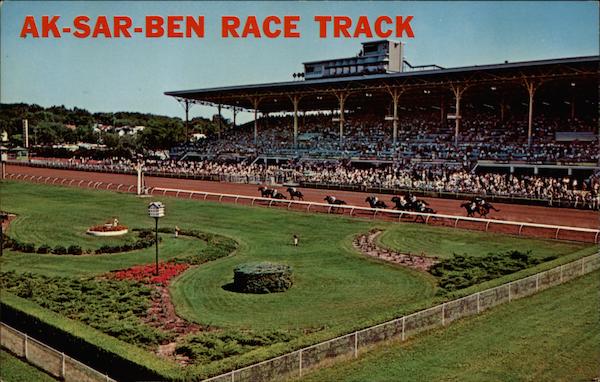
Vintage postcard of Ak-Sar-Ben
Ak-Sar-Ben
Founded in 1921, Ak-Sar-Ben was located in Omaha, Nebraska. By state law, racetracks in Nebraska must be run by non-profit organizations; the track in Omaha took it's name from the Knights of Ak-Sar-Ben, which ran the track in its early years. Ak-Sar-Ben was extremely popular. Buses brought fans in from as far away as Kansas City. In the mid-1980s, average daily attendance was 15,000 -- the 7th highest in the nation -- and in 1982 the track hosted a record crowd of almost 32,000. Average daily handle was also high ($1.7 million). Then the dogs came. In 1986, a greyhound track opened just across the state line in Iowa. Handle at Ak-Sar-Ben dropped by $450,000 a day; the dog track averaged $400,000 a day, clearly taking a huge chunk of the Thoroughbred track's business. Soon Thoroughbred tracks opened in Iowa and Missouri, Nebraska legalized keno, and Indian casinos opened within a hour's drive from Omaha. Ak-Sar-Ben was no longer the only game in town and it was disastrous. The track closed in 1995 after it was denied slot machines; Hall of Fame trainer Jack Van Berg believes if the track had been able to install slots, it could have been saved. The track was demolished and the land redeveloped into retail, residential and academic space.

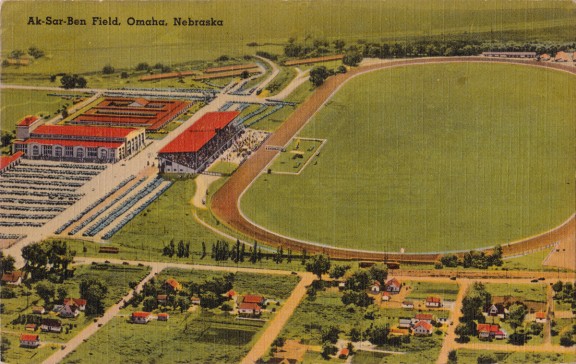
Vintage postcard of Ak-Sar-Ben
The marquee event at Ak-Sar-Ben was the Cornhusker Handicap, run at 1 1/16 miles from 1966 -1973, and at 1 1/8 miles thereafter. After the closure of Ak-Sar-Ben in 1995, it was moved to Prairie Meadows. Won in 1985 by the Jack Van Berg trained Gate Dancer (a quirky colt who deserves a blog post of his own), perhaps it's most famous winner at Ak-Sar-Ben was Black Tie Affair, who won the stakes in 1991 on his way to a win in the Breeders' Cup Classic at Churchill Downs. One other Classic winner has taken the Cornhusker on his way to Breeders' Cup glory: Fort Larned won the race in 2012 at Prairie Meadows before taking the big prize that fall at Santa Anita. The last winner of the Cornhusker at Ak-Sar-Ben was Powerful Punch in 1995.
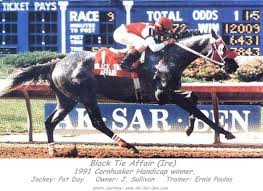
Breeders' Cup Classic winner Black Tie Affair (Ire) winning the 1991 Cornhusker Handicap
1935 Triple Crown winner Omaha was buried at Ak-Sar-Ben in May of 1959. A monument to him still stands in the Ak-Sar-Ben Circle of Champions. His grave now lies on the property of the University of Nebraska-Omaha, next to a culinary arts building. When a cooking project does come out as planned, the students are told to "Give it to Omaha" by tossing it out the window.

Omaha monument
While D. Wayne Lukas managed to take the training title at Ak-Sar-Ben in 1985, the greatest trainer in track history was Jack Van Berg, who not only topped the standings in 1984, but held the title for an incredible 19 years, from 1959-1977.

Bowie was a horseplayer's track. Opened in 1914 amidst the pine woods halfway between Baltimore and Washington, D.C., this Maryland oval was no place for the faint-hearted. In February 1961, a train derailed on the way to the track, killing 6 and injuring 200 more. Many die-hard bettors crawled out of the wreckage and continued on foot to the track in time to make their bets on the first race. One man had a broken collarbone; Hall of Fame trainer King T. Leatherbury recalled seeing men covered in blood waiting in line at the mutuel windows.

It wasn't only the horseplayers who were tough. Bowie specialized in winter racing starting in the late 1950s. Not much could cancel racing: the saying was "When it snows, Bowie goes." Jockey Sandy Hawley recalls riding "past snowdrifts three feet high" and one jockey went down in mud so deep that he was "buried alive". Luckily he landed face down, which meant he had a small air pocket that allowed him to breathe. Track management was known to throw big parties for the jockeys at the end of the day if they'd had to ride in a snow or ice storm. One trainer, trying to warm up his horse's bit by breathing on it before bridling the horse, ended up with his tongue frozen to the metal. In February, 1958, thousands of fans were stranded by a blizzard, spending the night at the track eating sandwiches, playing cards and shooting dice. These horsemen and horseplayers were known as the "Bowie Breed". They don't come tougher than that.


It wasn't just the weather that bred the "Bowie Breed." Over the years, 11 fires at the track killed 104 horses and destroyed several barns. Two days before opening day in 1946, a fire killed 21 horses and consumed a 56-horse barn; racing went on. Until 1947, the jockey's room had only 1 shower for around 50 riders. There was no enclosure separating the stretch from the fans until 1932.

Despite the rigors of racing at Bowie, it flourished for years. On November 21, 1941 a crowd of 30,000 turned out, causing a traffic backup of 5 miles. J. Edgar Hoover was often spotted in the dining room on Opening Day. Horses like Kelso and Kauai King raced at Bowie, and so did riders like Eddie Arcaro and Bill Shoemaker. Hall of Famer Chris McCarron rode there for four years; his older brother Gregg rode there for 15. Nearby Belair Stud was home to Triple Crown winners Gallant Fox and Omaha, as well as Preakness-Belmont winner Nashua.
In the 1970s, attendance and handle started to fall. On February 14, 1975 the track was the site of what local bettors called the "St. Valentine's Day Massacre." The final race of the day was "oddly run" and resulted in a very short trifecta payoff. Four jockeys were convicted of race fixing and banned from the track for 10 years. One, a promising apprentice named Eric Walsh, committed suicide after the verdict. Atlantic City casinos lured gamblers away and the last race at Bowie was run on July 13, 1985. The track became a training center, and has played host to stakes winners like Little Bold John and Captain Bodgit. In April 2015, the training center was closed, its barns no longer needed for overflow from Laurel. There is a possibility it could reopen as a training center in the future, although that seems unlikely. Bowie could withstand the elements, but changing times finally shuttered the doors.

Sources:

Bowie in 1915
BowieBowie was a horseplayer's track. Opened in 1914 amidst the pine woods halfway between Baltimore and Washington, D.C., this Maryland oval was no place for the faint-hearted. In February 1961, a train derailed on the way to the track, killing 6 and injuring 200 more. Many die-hard bettors crawled out of the wreckage and continued on foot to the track in time to make their bets on the first race. One man had a broken collarbone; Hall of Fame trainer King T. Leatherbury recalled seeing men covered in blood waiting in line at the mutuel windows.
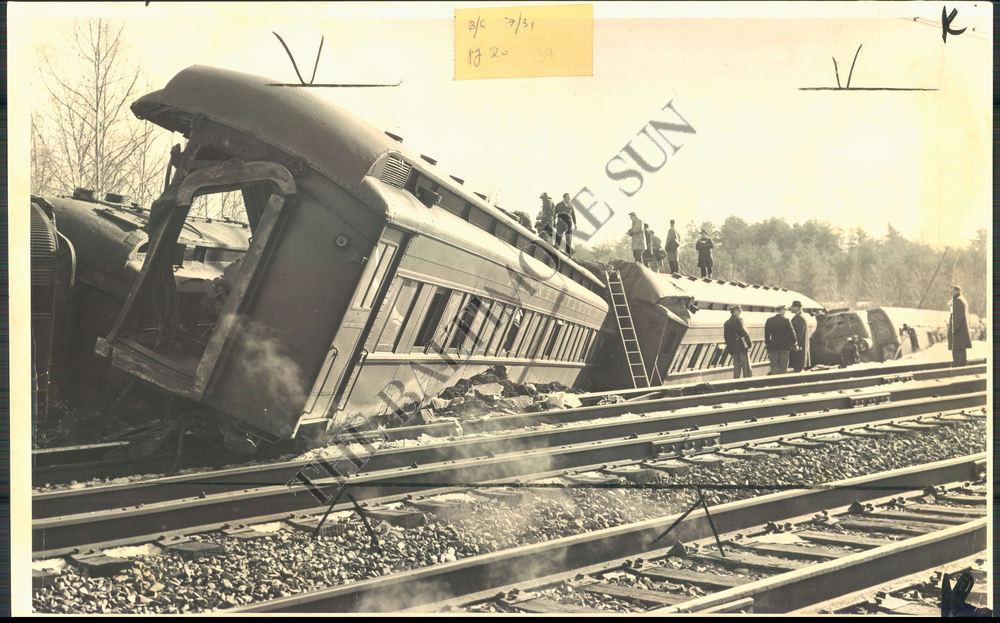
The train wreck in 1961

Winter racing at Bowie
The "Bowie Breed" didn't let a little snow stop them from watching the races
It wasn't just the weather that bred the "Bowie Breed." Over the years, 11 fires at the track killed 104 horses and destroyed several barns. Two days before opening day in 1946, a fire killed 21 horses and consumed a 56-horse barn; racing went on. Until 1947, the jockey's room had only 1 shower for around 50 riders. There was no enclosure separating the stretch from the fans until 1932.
Crowd at Bowie in the 1950s
Despite the rigors of racing at Bowie, it flourished for years. On November 21, 1941 a crowd of 30,000 turned out, causing a traffic backup of 5 miles. J. Edgar Hoover was often spotted in the dining room on Opening Day. Horses like Kelso and Kauai King raced at Bowie, and so did riders like Eddie Arcaro and Bill Shoemaker. Hall of Famer Chris McCarron rode there for four years; his older brother Gregg rode there for 15. Nearby Belair Stud was home to Triple Crown winners Gallant Fox and Omaha, as well as Preakness-Belmont winner Nashua.
In the 1970s, attendance and handle started to fall. On February 14, 1975 the track was the site of what local bettors called the "St. Valentine's Day Massacre." The final race of the day was "oddly run" and resulted in a very short trifecta payoff. Four jockeys were convicted of race fixing and banned from the track for 10 years. One, a promising apprentice named Eric Walsh, committed suicide after the verdict. Atlantic City casinos lured gamblers away and the last race at Bowie was run on July 13, 1985. The track became a training center, and has played host to stakes winners like Little Bold John and Captain Bodgit. In April 2015, the training center was closed, its barns no longer needed for overflow from Laurel. There is a possibility it could reopen as a training center in the future, although that seems unlikely. Bowie could withstand the elements, but changing times finally shuttered the doors.

Sources:
Ak-Sar-Ben
Bowie

No comments:
Post a Comment