Friday, November 27, 2015

Gone but Not Forgotten: Part 2

In this installment, we will look at two East Coast racetracks that had a huge impact on racing history, Garden State Park in New Jersey and Havre de Grace in Maryland.

Garden State Park

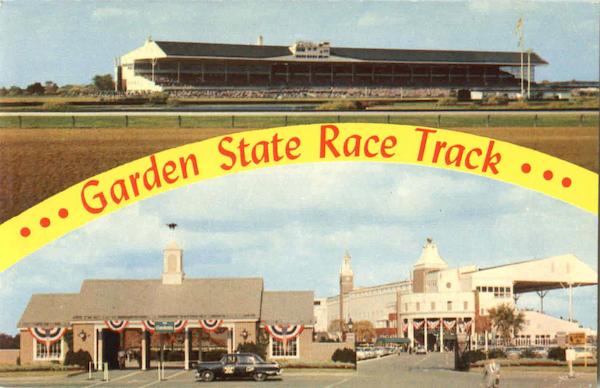
Vintage postcard of Garden State Race Track

Opened in 1942, Garden State Park once hosted the greatest of the great, including three Triple Crown winners.  During the first racing season, future Triple Crown winner Whirlaway won the Trenton Handicap.  In 1948, Triple Crown winner Citation picked up the Jersey Derby on his way from the Kentucky Derby to the Preakness Stakes.  Secretariat, the 1973 Triple Crown winner, captured the Garden State Stakes as a two-year-old in 1972.

Secretariat's win photo from the Garden State Stakes

Another great to race at Garden State was Bold Ruler, who won twice at the track in 1957, including a win over Gallant Man and Round Table in the Trenton Handicap.  Kelso and Riva Ridge also graced the Jersey track, which attracted up to 30,000 fans in its heyday with a 25 day meet in the spring and another 25 day meet in the fall.  Weekday crowds averaged 12,000 with weekend crowds twice that.  And then it all came to an end.

The horse and jockey on the top of the grandstand engulfed in flames

On April 14, 1977, a fire broke out in the old wooden grandstand while 10,000 fans were in attendance.  In just 10 minutes, the flames raced from one end of the stands to the other, and in 2 hours the entire building was completely destroyed.  Remarkably, there were only 2 deaths reported in what could have been an even worse tragedy.  The grand old Garden State Park was gone, but there was one more chapter in the story.

History going up in smoke

At a cost of $178 million, owner Robert Brennan replaced the wooden stands with a veritable racing "palace".  Marble floors, a covered paddock with a glass roof, and a club house resembling a Vegas casino welcomed fans when the track reopened in 1985.

The "new" Garden State Park

Brennan also offered a flashy new bonus: any horse who won the Cherry Hill Mile, the Garden State Stakes, the Kentucky Derby and the Jersey Derby would earn a $2 million prize.  That spring, a bay colt named Spend a Buck won the Mile on April 6, the Garden State on April 20, and went on to take the Kentucky Derby by 5 3/4 lengths on May 4 in 2:00 1/5.  Then all hell broke loose.  Instead of going on to the Preakness and an attempt at the elusive Triple Crown, Spend a Buck's owner, Dennis Diaz, opted to run in the Jersey Derby instead.  Racing fans were aghast.  Tradition and history were thrown over for a big monetary prize.  Spend a Buck won the Jersey Derby and with it a purse of $2.6 million.  As a result, the Triple Crown tracks created their own bonus system, with a sweep of the Crown worth $5 million and a $1 million yearly bonus awarded to the horse who earned the most points by running in all three races.  This bonus system eventually disappeared.

Spend a Buck winning the 1985 Jersey Derby

After such a spectacular start, it appeared that the new Garden State Park was a worthy reincarnation of the old track.  Alas, just three years before it opened, the first Atlantic City casino opened its doors and the era of off track betting and simulcasting was just beginning. Like so many tracks in the late 20th-century, Garden State fell victim to the competition from other forms of gambling.  Fans stopped coming to the track, which lost $23 million in its first year of operation and never did turn a profit.  Owner Brennan was convicted for bankruptcy fraud in 2001, which was also the final year of racing at the storied track.  That final season, average attendance was a measly 1,000 a day.  The last horse crossed the finish line on May 3, 2001.

Havre de Grace

Vintage postcard of Havre de Grace

Most recent horse racing fans associate the name Havre de Grace with the mare who won the 2011 Horse of the Year award with wins in the Apple Blossom-G1, Woodward-G1, and Beldame-G1 before finishing 4th in the Breeders' Cup Classic-G1.  But Havre de Grace the racemare was named for Havre de Grace the racetrack, a storied oval that has long been gone but has definitely not been forgotten.

Vintage postcard of Havre de Grace

Located on the Susquehanna River about 40 miles north of Baltimore, "the Graw" opened its door on August 24, 1912 for a five week meet.  The track was one of many that opened in Maryland after surrounding states, especially New York, banned parimutuel wagering.  Fans came to the Graw from New York City, Baltimore, Philadelphia, and Washington, D.C.  Both the Pennsylvania and Baltimore Ohio Railroads built stations near the track.  The track was built in less than two months for a cost of $125,000 plus the $10,000 cost of the property.  The land on which the track was built had farmed for decades and early on the track was very loose and cuppy because the land had been plowed and harrowed for so long.  It was not conducive to long striding horses, including one of the greatest of all time: Man o' War.

The immortal Man o' War

On September 18, 1920, "Big Red" was scheduled to run in the Potomac Handicap under an impost of 138 pounds, the highest he had been asked to carry so far.  The track was damper and looser than usual, and his trainer, Louis Feustel, has some concerns.  Could the big, long striding colt handle both the weight and the poor track conditions?  He thought about scratching, but owner Sam Riddle did not want to disappoint the fans -- and he also wanted to see just how much adversity his champion could handle.  The answer was: a lot.  Man o' War won the race in track record time, defeating that year's Kentucky Derby winner Paul Jones in the process.

Man o' War's son War Admiral  scored his first career win at the Graw on April 25, 1936 and won the Chesapeake Stakes on his way to the Triple Crown.  Man o' War's rival (and first Triple Crown winner) Sir Barton also raced at the Graw, making eight starts there after his Triple Crown sweep, including a win in the inaugural Potomac Handicap over his arch rival (and stablemate) Billy Kelly.

Crowds at Havre de Grace in its heyday

Other greats who raced at the Graw include Seabiscuit (a grandson of Man o' War), Exterminator, Sarazen, Equipoise, Discovery, Sun Beau, Crusader and Citation. The latter notched his first career win at the track, just like fellow Triple Crown winner War Admiral.  His only loss as a three year old was a second in the Chesapeake Trial to local runner Saggy.  Citation came back to win the Chesapeake on his way to the Triple Crown.

The Graw closed in 1950, when the property was turned over to the Maryland National Guard.  The clubhouse still stands, housing the National Guard offices; the lower grandstand was converted into a warehouse for the armory.

National Guard Armory at Have de Grace

Havre de Grace was in its final years in 1947; Garden State Park had only been open a few years.  Both tracks have a place in racing history, and for a few brief years, they hosted racing simultaneously, and both played host to the great Citation.  Between the two, they were host to five Triple Crown winners: Sir Barton, War Admiral, Whirlaway, Citation, and Secretariat.

Sources:
Garden State Park


Saturday, November 14, 2015

Gone but Not Forgotten : Part 1


When my Uncle Pud passed away in the early 1980’s he left me his collection of old horse racing books because he know I loved horses.  Pud was an Englishman and he loved playing the ponies.  In fact, the telephone had to be in my Aunt Genora’s name because he was a bookie!  Over the years, I’ve given away most of the books, which were about betting strategies and now hopelessly out of date.  But I have held onto the two American Racing Manuals, one from 1953 and the other from 1948.  I loved to browse through them and look at the pictures of champions of the past, but my favorite part was the section that contained diagrams of every racetrack in North America. Quite a few are still in business, but others have gone defunct, some of them quite famous.  The most recent, and highest profile, racetrack to crumble is Hollywood Park.  Here is the first in a series of looks at some other great tracks that were racing in 1947 (the year covered by the 1948 ARM) but no longer exist:

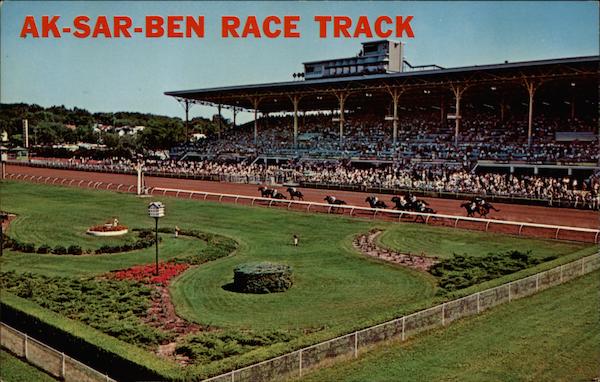
Vintage postcard of Ak-Sar-Ben

Ak-Sar-Ben
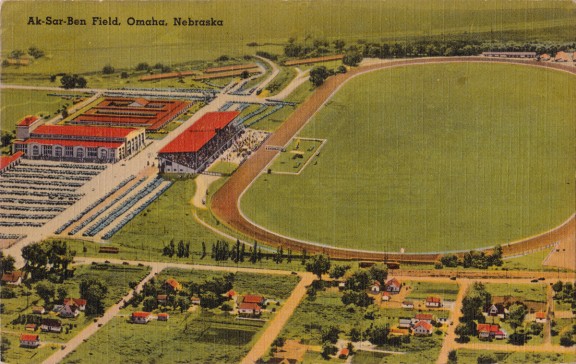
Founded in 1921, Ak-Sar-Ben was located in Omaha, Nebraska. By state law, racetracks in Nebraska must be run by non-profit organizations; the track in Omaha took it's name from the Knights of Ak-Sar-Ben, which ran the track in its early years. Ak-Sar-Ben was extremely popular. Buses brought fans in from as far away as Kansas City. In the mid-1980s, average daily attendance was 15,000 -- the 7th highest in the nation -- and in 1982 the track hosted a record crowd of almost 32,000. Average daily handle was also high ($1.7 million). Then the dogs came. In 1986, a greyhound track opened just across the state line in Iowa. Handle at Ak-Sar-Ben dropped by $450,000 a day; the dog track averaged $400,000 a day, clearly taking a huge chunk of the Thoroughbred track's business. Soon Thoroughbred tracks opened in Iowa and Missouri, Nebraska legalized keno, and Indian casinos opened within a hour's drive from Omaha. Ak-Sar-Ben was no longer the only game in town and it was disastrous. The track closed in 1995 after it was denied slot machines; Hall of Fame trainer Jack Van Berg believes if the track had been able to install slots, it could have been saved. The track was demolished and the land redeveloped into retail, residential and academic space.

Vintage postcard of Ak-Sar-Ben

The marquee event at Ak-Sar-Ben was the Cornhusker Handicap, run at 1 1/16 miles from 1966 -1973, and at 1 1/8 miles thereafter. After the closure of Ak-Sar-Ben in 1995, it was moved to Prairie Meadows. Won in 1985 by the Jack Van Berg trained Gate Dancer (a quirky colt who deserves a blog post of his own), perhaps it's most famous winner at Ak-Sar-Ben was Black Tie Affair, who won the stakes in 1991 on his way to a win in the Breeders' Cup Classic at Churchill Downs. One other Classic winner has taken the Cornhusker on his way to Breeders' Cup glory: Fort Larned won the race in 2012 at Prairie Meadows before taking the big prize that fall at Santa Anita. The last winner of the Cornhusker at Ak-Sar-Ben was Powerful Punch in 1995.

Breeders' Cup Classic winner Black Tie Affair (Ire) winning the 1991 Cornhusker Handicap

1935 Triple Crown winner Omaha was buried at Ak-Sar-Ben in May of 1959. A monument to him still stands in the Ak-Sar-Ben Circle of Champions. His grave now lies on the property of the University of Nebraska-Omaha, next to a culinary arts building. When a cooking project does come out as planned, the students are told to "Give it to Omaha" by tossing it out the window.

Omaha monument

While D. Wayne Lukas managed to take the training title at Ak-Sar-Ben in 1985, the greatest trainer in track history was Jack Van Berg, who not only topped the standings in 1984, but held the title for an incredible 19 years, from 1959-1977.


Bowie in 1915
Bowie
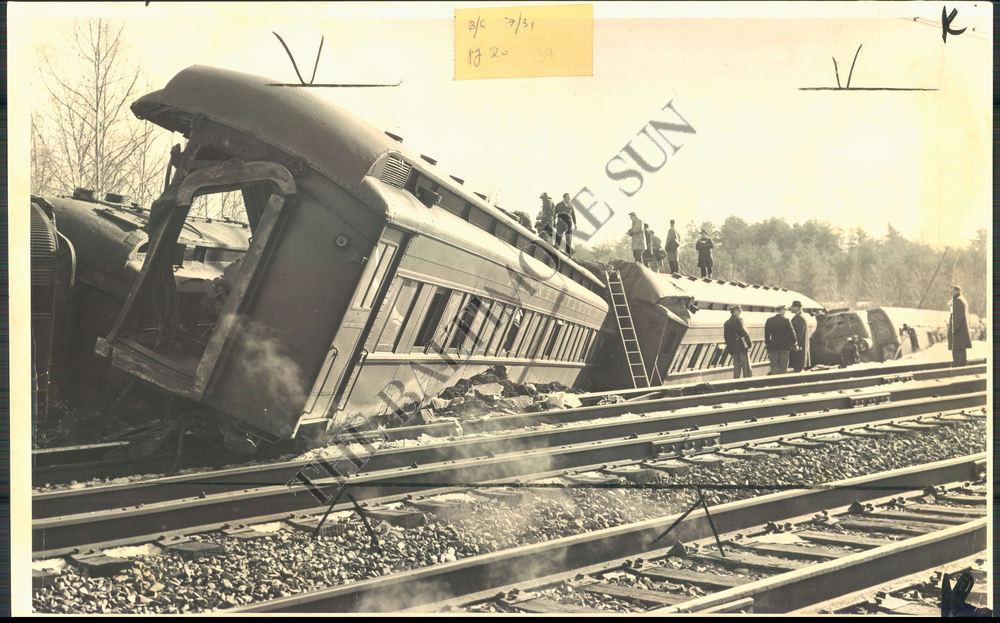
Bowie was a horseplayer's track. Opened in 1914 amidst the pine woods halfway between Baltimore and Washington, D.C., this Maryland oval was no place for the faint-hearted. In February 1961, a train derailed on the way to the track, killing 6 and injuring 200 more. Many die-hard bettors crawled out of the wreckage and continued on foot to the track in time to make their bets on the first race. One man had a broken collarbone; Hall of Fame trainer King T. Leatherbury recalled seeing men covered in blood waiting in line at the mutuel windows.

The train wreck in 1961

It wasn't only the horseplayers who were tough. Bowie specialized in winter racing starting in the late 1950s. Not much could cancel racing: the saying was "When it snows, Bowie goes." Jockey Sandy Hawley recalls riding "past snowdrifts three feet high" and one jockey went down in mud so deep that he was "buried alive". Luckily he landed face down, which meant he had a small air pocket that allowed him to breathe. Track management was known to throw big parties for the jockeys at the end of the day if they'd had to ride in a snow or ice storm. One trainer, trying to warm up his horse's bit by breathing on it before bridling the horse, ended up with his tongue frozen to the metal. In February, 1958, thousands of fans were stranded by a blizzard, spending the night at the track eating sandwiches, playing cards and shooting dice. These horsemen and horseplayers were known as the "Bowie Breed". They don't come tougher than that.

Winter racing at Bowie

The "Bowie Breed" didn't let a little snow stop them from watching the races


It wasn't just the weather that bred the "Bowie Breed." Over the years, 11 fires at the track killed 104 horses and destroyed several barns. Two days before opening day in 1946, a fire killed 21 horses and consumed a 56-horse barn; racing went on. Until 1947, the jockey's room had only 1 shower for around 50 riders. There was no enclosure separating the stretch from the fans until 1932.

Crowd at Bowie in the 1950s

Despite the rigors of racing at Bowie, it flourished for years. On November 21, 1941 a crowd of 30,000 turned out, causing a traffic backup of 5 miles. J. Edgar Hoover was often spotted in the dining room on Opening Day. Horses like Kelso and Kauai King raced at Bowie, and so did riders like Eddie Arcaro and Bill Shoemaker. Hall of Famer Chris McCarron rode there for four years; his older brother Gregg rode there for 15. Nearby Belair Stud was home to Triple Crown winners Gallant Fox and Omaha, as well as Preakness-Belmont winner Nashua.

In the 1970s, attendance and handle started to fall. On February 14, 1975 the track was the site of what local bettors called the "St. Valentine's Day Massacre." The final race of the day was "oddly run" and resulted in a very short trifecta payoff. Four jockeys were convicted of race fixing and banned from the track for 10 years. One, a promising apprentice named Eric Walsh, committed suicide after the verdict. Atlantic City casinos lured gamblers away and the last race at Bowie was run on July 13, 1985. The track became a training center, and has played host to stakes winners like Little Bold John and Captain Bodgit. In April 2015, the training center was closed, its barns no longer needed for overflow from Laurel. There is a possibility it could reopen as a training center in the future, although that seems unlikely. Bowie could withstand the elements, but changing times finally shuttered the doors.


Sources:
Ak-Sar-Ben


Monday, November 2, 2015

Goldsmith Maid : the Queen of the Turf

In recent years, Thoroughbred racing has been blessed by a plethora of talented fillies and mares who have vied for the title of “Queen of Racing.”  From Rachel Alexandra, to Royal Delta, to the incomparable Zenyatta, to the current queen Beholder, flat racing in the early 21st century will be remembered for the amazing girls who have taken on the boys and won.  But there was another Queen over 120 years ago who throws their records into the shade.  Her name was Goldsmith Maid.

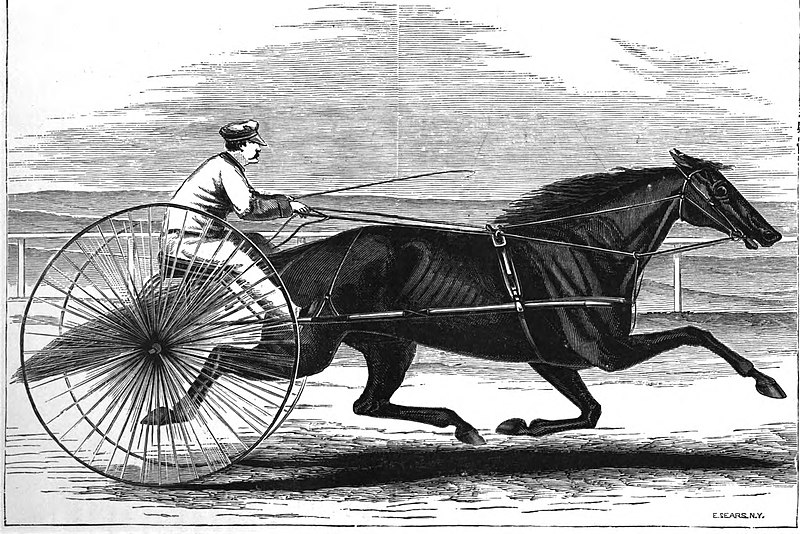
Goldsmith Maid, etching by John McAuliffe, published in 1877 in Famous American horses by Porter and Coates (Philadelphia: Henry B. Ashmead Publisher)

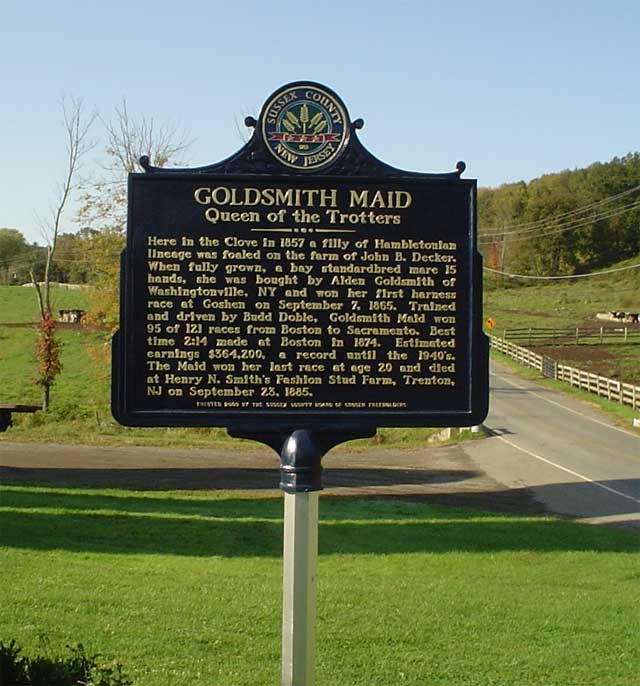
Goldsmith Maid was a trotting horse, who raced in an era when heat racing was still the norm.  Her career spanned thirteen years and 121 races (according to the historical marker at her birthplace) or 132 races (according to her New York Times obituary).  Those races encompassed more than 300 heats of a mile each, pulling the high-wheeled, 60 pound sulkies that were common at the time, a far cry from today’s low profile, light-weight “bikes.”  

Born in May, 1857 on John B. Decker’s farm in Deckerville, NJ she was a small, wiry blood bay who stood only 15 hands when fully grown.  Her dam was a mare by Abdallah, a grandson of the Thoroughbred stallion Messenger, the primary foundation stallion of the Standardbred breed.  Decker had bought her from a peddler and bred her to Alexander’s Abdallah, a son of Rysdyk’s Hambletonian, who was also sired by Abdallah.  Named Maid, the filly was closely inbred to the “famous rat-tailed stallion.”  

The historical marker at the Maid's birthplace in New Jersey

Unlike her mother, Maid was a wild child.  She was “ungovernable” and “wild as a prairie horse.”  She refused to work and was fond of jumping fences -- and kicking them down if they were too high to jump easily.  She fell over backwards when she was hitched to a harrow, kicked buggies to bits, and ran away with a wagon.  Known to the neighborhood as “Decker’s worthless mare,” she spend her days running wild in the fields until the age of eight, when she was sold to Decker’s nephew, John H. Decker for $260 at the urging of the elder Decker’s wife.  John H. sold her on to William Tompkins for $360 but regretted the sale.  He told Alden Goldsmith about the mare, who had often been “borrowed” from his uncle’s fields at night by local young men (in collusion with the hired man) to run in impromptu races.  Goldsmith bought her from Tompkins for $600 and sent her to William Bodine to be trained.  It took a while to teach her how to trot, but once she got the idea she became “perfectly tractable.”

Her racing career began at age eight on September 7, 1865 at Goshen, New York where she trotted against Uncle Sam, Mountain Boy, and Wild Irishman.  At the time, trotting races were run in heats.  Each heat was one mile and in order to win the purse, a horse had to win three heats.  Goldsmith Maid won her first race in three straight heats, trotting the mile in 2:39 in the first heat, 2:36 in the second, and 2:39 in the third.  She finished the year with two more races, winning one.  

At age 9, she trotted in eight races, winning seven.  The following year, at age 10, she won three of five races.  This was also the year of her first major race, on June 6 at Newburg.  She trotted the mile in 2:24 ¼. At age 11, in 1868, she won eight times, lowering her personal record for the mile to 2:21 ½ at Mystic Park on October 7.  She was sold that fall to Bud Doble for $20,000.

In 1868, at the age of 12, Goldsmith Maid became the first horse ever to go three heats in less than 2:20 each when she beat American Girl at Suffolk Park, Philadelphia.  Earlier in the year, she had been beaten by American Girl five times.  By the end of the year, she had won a total of eight races and beaten every horse who had beaten her that year, except for Lady Thorne, who beat her five times.  At age 13, the Maid won eleven times and went a mile in 2:24 ½ while hitched to a wagon.

"The brush on the homestretch : Between American Girl, Lucy, Bashaw Jr., Goldsmith Maid, Rhode Island and George Wilkes. In the last heat of their great trot on the Prospect Park Fair Grounds May 29th 1869" (Currier & Ives, 1869)


At age 14, in 1871, she beat all comers at Fleetwood Park, Baltimore, Prospect Park, Brooklyn, Boston, and Buffalo, where she attempted to beat Dexter’s mark of 2:17 ¼ for an extra purse, but failed.  Later on, she beat his mark at Milwaukee, going a mile in 2:17.  After that race, she was sold to Henry N. Smith for $35,000.  She continued racing on the Western Route, going as far west as Omaha and Council Bluffs. In 1872, she went in 2:16 ¾ at the Mystic course in Boston and went three heats in less than 2:20 two more times.  She also traveled to the West Coast for the first time.  She was 15 years old.

"The celebrated trotting mare 'Goldsmith Maid' driven by Bud Doble. Trotting in harness at Buffalo, August 11th, 1871, mile heats best 3 in 5, time 2:19 3/4, 2:19 1/4, 2:19, beating 'Lucy' and 'American Girl'" Currier & Ives, 1871.

According to Coates, she “did not trot any particularly fast heats” in 1873 but in 1874, at age 17, she won seventeen of seventeen races and went three heats in under 2:20 three times.  At Rochester, she went a second heat in 2:14 ¾.  On September 14, she trotted for a special purse at Mystic Park, Boston, trying to beat her own record set at Rochester.  She went the mile in 2:14, which would be her personal best. At age 18, she trotted six races, losing only once.  The following year she won seven of eight races, going three heats at Buffalo on August 3 in 2:16, 2:15 ¼, and 2:15.  On June 23, she matched her record of 2:14 at Belmont Park, Philadelphia, and went a mile in 2:14 ½ over the same track on November 4.

"The race between Goldsmith Maid and Rarus, Los Angeles, Ca." Carleton Watkins, c1877.

In 1877, the Maid was 20 years old and she once again raced in California.  On May 19 at Chico, she beat Rarus over “a rough track” (Coates) in 2:19 ½, 2:14 ½, and 2:17  Her last race was at Toledo on September 7, where she went three heats in 2:23 ½, 2:21 ½, and 2:22.  She retired at the age of 20 with a record of 95 wins (according to Coates) or 92 wins (according to the NYT obituary).  She earned $264,573 according to USTA records, but her driver Budd Doble “certified her winnings as $364,200” (Wrensch).  Perhaps the discrepancy was due to the special purses offered for beating time records.  At any rate, her official earnings record stood for many years until it was finally eclipsed in the 1920s by the Thoroughbred Zev.

She was so popular that “whole villages” would go to the depot to see her pass through town in her private rail car.  In autumn 1876, the employees of a shoe factory in North Brookfield, Massachusetts walked 35 miles to see her race at Springfield.

Sheet music for the "Goldsmith Maid galop, Occident polka, Lucy march", published c1872. Popular music was often written about popular figures, including famous racehorses.


In addition to all the miles Goldsmith Maid trotted, she traveled over 130,000 miles by rail.  Horses were expected to be tougher in those days, which is illustrated by one race she participated in on July 27, 1876 at Cleveland.  My description is based on an eyewitness account by Hamilton Busbey.

Five horses entered the race: Goldsmith Maid, Smuggler, Lucille Golddust, Bodine, and Judge Fullerton.  Harness races do not have a standing start like flat races; the horses trot toward the starting line so that they are at or close to racing speed as they cross the line.  In the first heat, there were two false starts, and the field was sent away on the third try.  Goldsmith Maid went straight to the lead.  At the half mile, Smuggler drew near but then faltered.  He had thrown a shoe from his near fore.  By the finish, however, he “had his nose at the Maid’s tail” as she won the heat in 2:15 ½.  The judges thought that Smuggler would have won the heat had he not lost a shoe.  

The second heat needed four tries to start.  Once again, Goldsmith Maid took the early lead.  Smuggler broke stride on the turn and ended up finishing fifth.  Lucille Golddust finished second to Goldsmith Maid, who took the heat in 2:17 ¼.  The Maid “was distressed” after the heat, but in order to win the race, she would have to win a third heat.  The horses rested and then returned for the next heat.  Again, Goldsmith Maid took the early lead but “went into the air around the turn.”  She was “quickly caught” and continued steadily down the backstretch with Judge Fullerton just behind.  At the half mile, Smuggler was sent and passed Lucille Golddust and Judge Fullerton to take second place and enter the homestretch “hard on the Maid’s wheel.”  He drew even with her and at the wire prevailed by ¾ length in 2:16 ¼.  The crowd went wild.  The score now stood Goldsmith Maid - 2, Smuggler - 1.  The gallant mare “stood with trembling flanks and head down,” but there was at least one more heat to trot.  If she won, she would take the purse; if Smuggler won, he would need another heat to triumph; if someone else won, who knew how many heats it would take to establish a clear winner?

Lithograph of Smuggler

In the fourth heat, Lucille and the Maid vied for the early lead, with Smuggler stuck behind them.  Doble (Goldsmith Maid’s driver) let the other mare take the lead, which allowed him to keep Smuggler in a pocket.  But Marvin (Smuggler’s driver) took his horse back and pulled out to the right to make a bid with 150 yards to go.  Smuggler won the heat by a neck in 2:19 ¾.  He cooled out well, but the Maid was still tired.  

Before the fifth heat, Lucille Golddust and Bodine “worried [Smuggler] by repeated scorings” and he tore off the shoe he had already lost.  It was reset, but the delay gave Goldsmith Maid a chance to catch her “second wind.”  Smuggler lost his shoe a third time, and again it was reset.  His hoof was “badly splintered” but he was not lame.  In all, the fifth heat was delayed by an hour with all the shoeing and scoring, which meant the others were relatively fresh compared to Smuggler.  Judge Fullerton took the early lead, going the first quarter in :33.  Smuggler took over at the half mile and was never headed, winning the heat in 2:17 ¼ with Goldsmith Maid second.  The final score was Smuggler - 3, Goldsmith Maid - 2.  Smuggler won the purse.

In the course of a single race, the participants trotted a total of 5 miles at top speed, plus whatever distance they covered in false starts and while warming up (scoring) and cooling down.  Smuggler lost a shoe on the same foot three times and went the final heat with a damaged hoof.  Such a thing would be unthinkable today!

Goldsmith Maid retired at the age of 20 to Fashion Stud Farm in Trenton, New Jersey.   She produced three foals, including an 1879 colt by George Washington;her  owner reportedly refused an offer of $20,000 for him on the day of his birth.  The colt’s sire was a son of Lady Thorne, the only horse Goldsmith Maid was unable to beat in the year 1868.  

The Maid died on September 23, 1885 at the age of 28.  The cause of death was “fatty degeneration and enlargement of the heart.”  She had been retired for 7 years and was something of a local tourist attraction.  Hundreds of visitors came to the farm to see her on summer Sundays and holidays.  She was inducted into the United States Trotting Association Hall of Fame in 1953, nearly a century after her birth.

Goldsmith Maid ran wild for eight years, raced for thirteen, and was retired for seven.  Almost half her life was lived between the shafts of a racing sulky.  Compared to today’s flat racers who retire after two years with perhaps a dozen starts, she was a true Iron Horse.  More importantly, she was an ambassador for the sport, bringing harness racing into the spotlight and the hearts of Americans from coast to coast.  Whether trotting in front of a sulky or running on the flat or over jumps, racing has always been about the horse above all.  And Goldsmith Maid was certainly “one of the ones,” those rare horses who transcend the sport and shine brightly down the years.  

Sources :


“Goldsmith Maid a Mother.” New York Times, 2 Apr 1879. : http://query.nytimes.com/mem/archive-free/pdf?res=9A00E2D9123EE63BBC4B53DFB2668382669FDE

Wrensch, Frank Albert. Harness horse racing in the United States and Canada. Van Nostrand: New York, 1948.

Busbey, Hamilton. The trotting and pacing horse in America. Macmillan: New York, 1904.

Durant, John and Otto Bettmann. Pictorial history of American sports : from colonial times to the present. Rev. ed. New York : A.S. Barnes, 1965.