
image from Library of Congress collection (www.loc.gov)
Who is the greatest California-bred Thoroughbred of all time? A good argument can be made for Ancient Title (1975 Hollywood Gold Cup, Whitney Handicap winner), Best Pal (1991 Pacific Classic winner), Decidedly (1962 Kentucky Derby winner), Flying Paster (runner up to Spectacular Bid in 4 1980 Stakes at Santa Anita), Hill Rise (1965 Santa Anita Handicap winner, 2nd to Northern Dancer in the 1964 Kentucky Derby), Native Diver (3 time Hollywood Gold Cup winner in the late 1960s), Swaps (1955 Kentucky Derby winner) and Tiznow (2 time Breeders’ Cup Classic winner). But until Swaps thundered into Kentucky and took down the Kentucky Derby over the great Nashua in 1955, this question would almost certainly have been answered with the name Emperor of Norfolk.
You may not recognize the name, but if you have visited Santa Anita Park in Arcadia, CA you have walked past the Emperor’s grave. Just inside the east general admission gate is a stone monument in the shape of a giant Maltese cross. If you pause before hurrying to buy your program and find a good seat, you can read the bronze plaque naming the four American Derby winners buried here, including Emperor of Norfolk. All four champions were owned by Elias J. “Lucky” Baldwin, who originally owned the land on which Santa Anita Park sits. During the last two decades of the 1800’s, the American Derby was more important than the Kentucky Derby. Held at Old Washington Park in Chicago until 1905, the race is still held today at Arlington Park and is currently a Grade 3 turf stakes for 3 year olds. Over the years it has been run at different distances on turf and dirt. Past winners include Citation, Native Dancer, Swaps, Round Table, Buckpasser, and Damascus.
Emperor of Norfolk was born in 1885 at El Arroyo Stud, owned by Theodore Winters. His sire was Norfolk, an undefeated son of the great Lexington; his dam, Marian, produced 9 stakes winners. Baldwin bought the bay colt as a yearling for just over $2,500 and sent him back East to race. His first start came on July 2, 1887 at Chicago. Within a week, the colt had won three stakes races. Shipped to Saratoga, he won four more stakes in a two week span. Next he shipped to Monmouth, where he threw in a clunker, finishing 8th in the Select Stakes. He rebounded quickly, taking the Autumn Stakes at Sheepshead Bay just 10 days later. The “California Wonder” added two more stakes wins to his resume before the end of the year, finishing the season with earnings of $36,490 and a record of 12 wins (10 stakes), 2 second, and 3 thirds from 18 starts.
At three, the Emperor took down 9 wins from 11 starts (7 stakes), including the Brooklyn Derby and the American Derby, where he defeated Belmont winner Sir Dixon. He was retired midway through his 3 year old season with a bowed tendon with a career record of 21 wins from 29 starts and earnings of $72,400.

image from www.saratoga150.com
Emperor of Norfolk was retired to stud at Baldwin’s Rancho Santa Anita, which stood just west of Santa Anita Park on the grounds of the current Los Angeles County Arboretum. He sired several stakes winners, including Cruzados, a talented sprinter whose descendants carry on the sire line of the great Lexington to this day, and Americus. Raced in the U.S. as Rey del Carreres, Americus was renamed when he was sold and shipped to Great Britain. His daughter, Americus Girl, was the dam of the famous “flying filly” Mumtaz Mahal, herself the ancestress of prominent stallions Mahmoud, Nasrullah, and Sunday Silence.
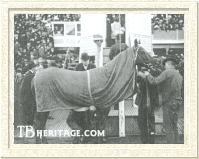
Cruzados
image from www.tbheritage.com
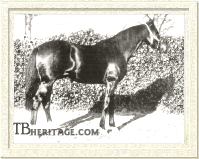
Americus
image from www.tbheritage.com
Emperor of Norfolk succumbed to old age on December 15, 1907 at the ripe age of 22, just 8 days after Baldwin’s dream of a racetrack in California came true: the old Santa Anita Park opened on December 7, 1907. Baldwin was 80 years old and would live less than 2 more years. His racetrack only operated for 2 years but was the inspiration for the storied track that would be built in 1934 on ground lying between the old Rancho and Baldwin’s track.
Sources:
Horse Racing Nation : www.horseracingnation.com
Forney, Mary. “Lucky Baldwin’s Maltese Cross” : http://maryforney.blogspot.com/2008/10/lucky-baldwins-maltese-cross.html
“Emperor of Norfolk” : https://www.racingmuseum.org/hall-of-fame/emperor-norfolk
Ginsburg, Deborah. “‘Lucky’ Baldwin : A Legend Larger Than Life” : http://archive.ctba.com/99magazine/apr99/aprnews1.htm
“Emperor of Norfolk” : http://www.tbheritage.com/Portraits/EmperorofNorfolk.html
Library of Congress : http://www.loc.gov/pictures/resource/cph.3b50166/

Enjoyed this very much! Well done, Julie!
ReplyDelete