This is a story of star-crossed lovers. Landaluce and Roving Boy were the class of the 1980 crop, champions at two whose potential was tragically never fulfilled. And the hearts broken were not their own, but those of their trainers. Such is the love we hold for special horses.
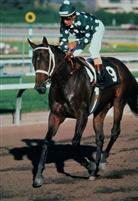
Landaluce on the track at Santa Anita
Landaluce is the more famous of the pair. Born at Spendthrift Farm in Kentucky on April 11, 1980, she was a bay filly by Triple Crown champion Seattle Slew out of the Bold Bidder mare Strip Poker. Spendthrift sold her at the 1981 Keeneland yearling sale for $650,000 to Beal and French, who named her after a Basque hunting guide they had met in Spain the year before. Her new owners sent her to the barn of D. Wayne Lukas.
At age two Landaluce was undefeated, winning a maiden special weight by 7 lengths in early July, then jumping to graded stakes competition, taking down the Hollywood Lassie-G2, Del Mar Debutante-G2, Anoakia-G3, and Oak Leaf-G1 under the guidance of Laffit Pincay, Jr. She won those five races by a combined total of 46 ½ lengths. In the Lassie, she scored by 21 lengths in 1:08 flat, the fastest time ever for a 2-year-old filly at the distance. She won the Debutante by 6 ½, the Anoakia by 10, and the Oak Leaf by 2. Already nearly assured of the Champion Two-Year-Old Filly title, her next goal was the $500,000 added Hollywood Starlet, at the time the richest race ever for two-year-old fillies (this was two years before the Breeders’ Cup and it’s $1 million purses). A win in the Starlet would send her past Buckpasser’s record for earnings by a two-year-old and on to a possible showdown with the nation’s top colts in the $800,000 added Hollywood Futurity.
The Starlet would be run on Sunday, November 28, 1982 at Hollywood Park. A week before the race, all systems were go, but on Monday Landaluce spiked a fever of 103. A virus had been going around the barns at Santa Anita where she was stabled, affecting close to 30 horses. The champion filly was placed under round the clock vet care in hopes of getting her over it. By the middle of the week, her lungs had begun to fill with fluid, and by Friday she needed help to stand up and was only able to sit up by propping herself against the wall of her stall. The respiratory infection left her throat so inflamed that she could only eat liquids and wisps of hay. Instead of preparing for the biggest race of her career, the filly was fighting for her life. On Saturday, the day before the Starlet would be run, she perked up a little, raising hopes that she might survive the devastating illness even if she never raced again. As one of the first daughters of Seattle Slew, she had a bright future as a broodmare. Lukas, who had been by her side throughout the ordeal, left her for a few hours late Saturday night, returning around 3:00 am. He was with her when she lay down for the last time at 5:45 am. Twelve hours before post time for the Starlet, Landaluce lost her final race. I could not find confirmation, but at the time I remember hearing a rumor that she died with her head in Lukas’ lap. Steve Crist reported in the New York Times, “about the time she would have taken her usual morning nap … her body was dragged onto a van, covered with sacks of ice, and sent to a laboratory at the University of California in Davis for an autopsy ….” Instead of celebrating a superstar in the Starlet, Hollywood Park lowered its flags t0 half-staff. Although she died at Santa Anita, Landaluce was buried at Hollywood Park, the site of her scintillating 21 length win the Lassie, which would be renamed in her honor. When Hollywood Park was razed in 2014, her remains were disinterred and transferred to her birthplace, Spendthrift Farm. Landaluce was the only fatality of the viral breakout at Santa Anita that fall. She was posthumously voted Champion Two-Year-Old Filly of 1982.

Landaluce's grave marker in the infield at Hollywood Park
Had Landaluce won the Starlet and then gone on to the Hollywood Futurity, she would have faced another ill-fated two-year-old star, a colt named Roving Boy.
Roving Boy was born in Kentucky on February 9, 1980. A bay colt by Olden Times out of the Prince Royal II mare Black Eyed Lucy, he was owned and bred by Robert E. Hibbert. Sent to the California barn of Joe Manzi, he was not as precocious as Landaluce, taking three tries to break his maiden, but once he passed that barrier, the rest of his season was a winning one. Jumping into stakes company, he took down the Balboa Stakes, Del Mar Futurity-G2, and Norfolk Stakes-G1. Next up was the richest race ever for two-year-olds, the $800,000 added Hollywood Futurity. Supplemented to the race for $40,000, Roving Boy took the lead from Desert Wine in the stretch and won by a neck, with 3-2 favorite Copelan a badly beaten 5th. The win in the Futurity clinched the Eclipse Award for Champion Two-Year-Old Colt of 1982, especially since it pushed his earnings over $800,000, the most ever earned by a two-year-old. The bay colt was now also the winter book favorite for the 1983 Kentucky Derby.

Roving Boy and trainer Joe Manzi
He returned to the races in mid-October, running second in an allowance at Santa Anita. On November 2, he returned to stakes competition in the $60,000 Alibhai Handicap-G3 at 1 1/16 miles. The three screws that had held his cannon bone together as it healed were in his owner’s pocket. If all went well, the colt would venture outside California for the first time to run in the Meadowlands Cup later in the month, with the ultimate goal to participate in the top handicaps as a 4-year-old.
Roving Boy showed his winning spirit, taking the Alibhai by a nose but the celebration was short lived. Just a few strides past the wire, he collapsed, both hind legs shattered. Trainer Joe Manzi rushed onto the track in tears as his colt struggled to rise in front of the clubhouse. Roving Boy was loaded into the horse ambulance and rushed to the Santa Anita Equine Hospital on the backstretch. Both the ambulance and hospital were built with funds from the Oak Tree Racing Association, which ran the fall meeting at Santa Anita from 1969 until 2009. Four veterinarians examined the colt’s X-rays and found tibia fractures in both hind legs. One bone was so badly broken that according to Dr. Greg Ferraro, “we wouldn’t have had enough to work on.” The decision was made to put the champion down. Hibbert did not insure his horses, and the colt was worth at least $5 million as a stallion prospect. He was buried on the backstretch at Santa Anita, alongside champions Lamb Chop and Quicken Tree.
.JPG)
The final resting place of Roving Boy, Lamb Chop and Quicken Tree
During the 1980’s and early 90’s, as he ran horse after horse in the Triple Crown and other graded stakes races, D. Wayne Lukas developed a reputation as a “numbers” guy, the sort of trainer who bought lots of horses and threw them into the fray, racking up high profile wins by dint of sheer numbers. I always felt as though the horses were just cogs in his winning machine, especially after Horse of the Year Lady’s Secret was sent to the gate long after she’d made it clear she was done with racing, simply to chase the earnings record for a female horse. And yet, there is that image of him sitting in Landaluce’s stall, holding her head in his lap as she breathed her last. I have always wondered if his indifferent facade was a result of a broken heart.
Horses come and horses go, but some touch us more than others. Losing them can be devastating, but without an open heart, we can never know the heights of glory this sport can reach.
Sources:
www.equibase.com
Christine, Bill. “Breeders’ Cup Won’t Return Soon.” Los Angeles Times. 17 Nov 1989 : http://articles.latimes.com/1989-11-17/sports/sp-1602_1_breeders-cup-races/2
Hovdey, Jay. “Premier Pegasus latest reminder of just how fragile racehorses are.” Daily Racing Form, 8 Apr 2011 : http://www.drf.com/news/premier-pegasus-latest-reminder-just-how-fragile-racehorses-are
“Roving Boy wins but is destroyed.” Washington Post. 3 Nov 1983: http://www.washingtonpost.com/archive/sports/1983/11/03/roving-boy-wins-but-is-destroyed-from-news-services/a0a4d073-3954-432c-97fd-93351ee32f01/
“Roving Boy wins Hollywood Futurity.” Ocala Star-Banner, 13 Dec 1982 : https://news.google.com/newspapers?nid=1356&dat=19821213&id=77JPAAAAIBAJ&sjid=5AUEAAAAIBAJ&pg=6448,4160152&hl=en
Crist, Steven. “Landaluce dies from virus.” New York Times, 29 Nov 1982. : http://www.nytimes.com/1982/11/29/sports/landaluce-dies-from-virus.html?pagewanted=all
Kudler, Adrian Glick. “They’re digging up all the dead racehorses at Hollywood Park”. Curbed LA, 10 Mar 2014 : http://la.curbed.com/archives/2014/03/theyre_digging_up_all_the_dead_racehorses_at_hollywood_park.php
http://www.tbheritage.com/TurfHallmarks/Graves/GraveMattersFarmNAM.html
“Roving Boy Out of Derby” : http://www.nytimes.com/1983/02/01/sports/roving-boy-out-of-derby.html
Christine, Bill. “Price Tags for Claimers Has Reached $100,000”. Los Angeles Times, 17 Jul 1986 : http://articles.latimes.com/1986-07-17/sports/sp-21374_1_highest-claims
Steve Crist on Horse Racing, New York Times, 4 Nov 1983 : http://www.nytimes.com/1983/11/04/sports/018345.html